
Don’t Use Your Suppliers as a Bank

Have you considered the importance of your supply chain, and the part you play in it?
Whoever named the relationship between manufacturers, suppliers, transporters and retailers a "supply chain" was pretty clever. A chain is made of strong links of equal importance. If one of the links breaks, the whole chain is broken and it’s rendered useless.
Each link in the chain relies on the other links for its strength and robustness.
You're a retailer, so your link is often the last in your supply chain. You rely on all the businesses before you to do their job well so that you have something to put on your shelf to sell.
These could be distributors, manufacturers, transport companies, raw material suppliers, packaging companies, and probably a whole bunch more of which you're not even aware. If any one of these links in your chain fails, you won't be able to get the products you want to sell from that supply chain.
So, I have to ask myself, why is it that retailers inevitably put those in their supply chain at risk by not paying them on time or stretching the friendship by extending the credit that the supplier has provided? How can a retailer expect those in their supply chain to continue to afford to manufacture and supply products for them, if the retailer doesn't actually pay them what they're due?
The retailer is usually at the cash-receiving end of the supply chain. It's the retailer that gets the money from the end user and if it's not immediately, it's usually within a few days whereas everyone else has to wait until the money gets passed backwards down the chain.
But if the retailer holds on to this cash and doesn't pay their suppliers on time, how do they pay their suppliers, and so on?
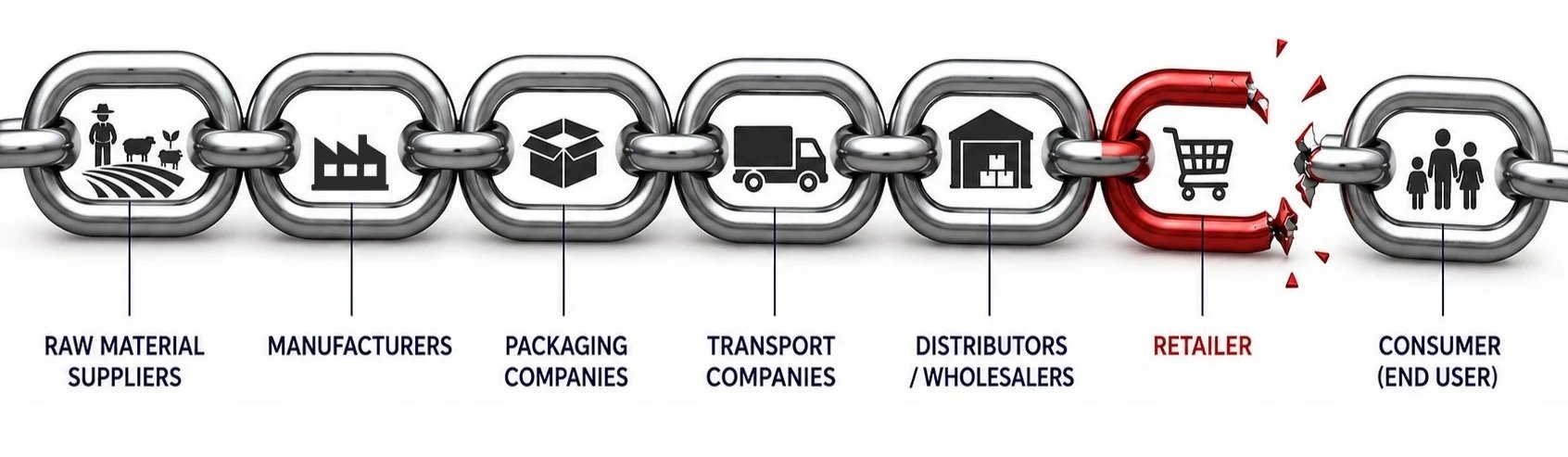
In the end, who pays the price? Well, the retailer will eventually pay because the supplier will usually do one of three things:
Refuses to sell to the retailer that becomes a risk, possibly sends in a debt collector, and then finds better customers that do pay.
Increases their prices, takes away credit, and stops providing priority service to that retailer.
Goes out of business because they're owed money leaving the retailer somewhat oblivious as to how they may have been part of the problem.
A LESSON FROM MY DAYS AS A SUPPLIER
One of my businesses was wholesale production nursery growing plants for retail nurseries, and at that time I had a retail customer who I liked and knew quite well. She was a lovely person and her nursery was beautiful but she never paid me on time, and indeed often paid quite late. The credit terms I gave her were generous - 30 days after the end of the month. Being herbs and veggies, these were high turnover plants and would have sold long before the invoice even fell due.
In frustration, I asked her why she'd never pay on time. Her response was, "You don't understand. I have to pay rent, wages, outgoings and all the other costs to run my business. It's really tough being in retail."
I didn't disagree that retail was tough, but I had to remind her that I also had rent, wages, outgoings and all the other costs to run my business. Worse, being a plant grower, I also had to buy all the materials needed to grow the plants and then the pay the wages to seed and maintain them months before I even delivered them to her nursery. So, with that and the 30-day EOM terms she had, there could be up to five months between when I had to pay out for materials and when I might actually receive payment from her. It also wasn’t lost on me that she got paid straight away, or within a few days, from her customers when selling my products but I had to wait months for her to pay me.
If I had let that situation continue and allowed other retailers to do the same, it would have impacted my cash flow and made it difficult for me to purchase the materials I needed to grow more plants.
The outcome? She was using me as a bank. I was a plant supplier, not a bank. So, I stopped supplying her, and went off and found better customers who actually paid me on time.
“You can’t build a strong retail business on a weak supply chain. And you can’t have a strong supply chain if you’re the weak link in it.”
A ‘LOYAL’ CUSTOMER IS NOT THE SAME AS A ‘GOOD’ CUSTOMER
After I moved into retail myself, and later when working with retail business owners more broadly, I saw this exact pattern repeat itself and often with a key supplier that the retailer couldn’t afford to lose.
The scenario often went like this. The retailer falls behind on payment with one of their most crucial suppliers. The supplier eventually gets fed up and cuts them off. They won’t fulfil any further orders until the outstanding balance is paid. The retailer becomes annoyed because they’ve been a ‘loyal customer for years' and ‘the supplier needs me to sell their product’.
The retailer forgets that yes, they might have been a customer for years, but if they’re not paying on time, they’re not a good customer. In fact, the supplier is probably better off without them.
And here's the trap for the retailer. By the time their supply is cut, the retailer doesn't just owe for that first overdue order, they probably owe for subsequent ones as well and now they’ve dug a bit of a hole that they’re struggling to climb out from.
The other problem is, if the retailer is able to pay their debts off and supply is restored, it's rarely back to business as usual. Most suppliers will move that retailer onto COD until trust is rebuilt, which only adds more pressure to an already stretched cash flow.
If you ever end up in a situation where you can’t pay within terms, the worst thing you can do is place another order anyway and hope it comes through. Pick up the phone and speak to the supplier. Set up a payment plan before it becomes a crisis, not after, and manage the debt in smaller increments until you’re back on track. A retailer that isn’t communicating when there’s debt to be paid makes a supplier nervous and then angry to the point where they need to take action and have also lost trust. Silence is what turns a cash flow hiccup into a broken relationship.
Without a resilient and robust supply chain, no retailer will have a reliable supply of quality products — and that's the foundation of any retail business.
SO, ARE YOU THE WEAKEST LINK?
Before you write this off as someone else's problem, have a quick, honest look at your own payment habits and decide if you’re a weak link in the supply chain:
Are you paying your suppliers within their stated terms, or do you quietly stretch them out because it's convenient?
Do you know which of your suppliers you've come to rely on most and how they're affected when you hold onto their money a little longer?
If you can see a payment problem coming, have you actually told your supplier, or are you hoping it'll sort itself out?
You can't build a strong retail business on a weak supply chain. And you can't have a strong supply chain if you're the weak link in it.
Pay your suppliers like you'd want to be paid. They're not your bank — they're your business partners.
HOW DO YOU RATE AS A CUSTOMER?
If you want to know how you've actually performed in paying your suppliers there are two options.
Both Xero and MYOB will show you what’s outstanding right now if you run an Aged Payables report, although this isn’t a history of how late you've tended to pay over time. Unfortunately neither will hand you a ready-made report card for the last 12 months but you can get a historical picture with a few minutes’ work:
In Xero, run the Payable Invoice Summary report for the last 12 months and turn on the Due Date and Last Payment Date columns. It will list every invoice in that period with both of these dates already filled in. Export that to a spreadsheet and then add one simple formula (eg. =E2-D2) at the top of the next column to calculate the gap between these two dates.
In MYOB AccountRight, the Supplier Analysis view under Business Insights gives you a purchase history with each supplier, including how overdue payments have run against their terms.
If you're genuinely unsure as to whether you've been a reliable payer or a repeat offender, twenty minutes with a spreadsheet will tell you the truth a lot faster than your memory will.