
Brand Identity (Part 2) - The Building Blocks of a Retail Brand

In Part 1, we talked about the difference between a logo, a brand, and a brand story and why stopping at the logo is a mistake. So if a logo is just the coat hanger, what are the clothes?
That's what this article is about. The practical building blocks that work in conjunction with your logo and make your brand look and sound like a coherent, recognisable business no matter who's creating the content or where a customer sees it.
Let's work through them one by one.
THE BRAND COLOURS
This is usually where business owners have done some work because they probably needed it for their logo. They know their brand colours, at least vaguely, but vaguely isn't good enough when you're briefing a designer, ordering signage, or setting up your website.
Your colours need to be documented precisely, and there are three layers to understand:
Primary colours are the core colours used in your logo. These are non-negotiable and should be specified by their exact codes — PMS (for print), CMYK (for professional printing), and Hex (for digital). Don't leave this vague. "A sort of teal-green" is not a brief that a designer can work with, it's a recipe for brand slippage every time someone else touches your artwork.
Your accent colour — I call it the pop colour, because that's its job. It's used sparingly to draw attention such as on sale signs and call-to-action buttons and when highlighting pricing. Think about how Coles uses yellow against their red and white, or how David Jones uses gold to add a premium feel to their black and white brand, or Bunnings uses the orange on their price signs. Your accent colour isn't everywhere, it's only where you need people to look.
Secondary colours complement your primary palette and give you more to work with across your fit-out, uniforms, website, and supporting graphics. They're about balance and harmony rather than impact. BCF's primary brand is blue, white, and orange — but their secondary colours extend into yellow and red for pricing and call-outs. Country Road uses soft blues, greens, and muted warm tones, but you probably knew that already, without even thinking about it. That's a secondary colour palette doing its job and their often better shown as images within a mood board.
One more thing. Give your colour range a name such as coastal tones, earthy naturals, rich jewels. Once you name it, you can articulate it to designers, your team, and to yourself when you're tempted to go off-brand on a busy afternoon.
TYPOGRAPHY (FONTS)
Your fonts do more work than most people realise. They carry the personality of your brand in every piece of written communication, whether that’s emails and websites or signage and brochures.
There are four fonts to think about:
Primary header font — used for headlines, call-to-actions, and anything that needs to grab attention. This is usually the font with the most personality. Often a little bit flamboyant. On this page, you can see the font ‘Lora’ used in the heading of this and I use it on images and brochures.
Primary copy font — the workhorse. Used for body text on your website, brochures, product labels, and emails. It needs to be easy to read at small sizes, and it needs to work in bold as well as regular weight. It’s what your reading right this very second and in this case it’s Plus Jakarta Sans.
Secondary font — used sparingly, like your accent colour. It might appear on campaign graphics, pull quotes, or supporting text where you want to add a little visual interest. The key word is sparingly. For example, every now and then I might use Jeff Script with a cute little arrow on an image, such as here.
Online fallback font — this one gets overlooked constantly. Many email platforms and website builders can't render custom fonts so you need a fallback, usually something common like Arial or Georgia that mimics your primary fonts as closely as possible so your brand doesn't fall apart when it’s sent to someone’s inbox.
Once you’ve decided what these fonts are, document them and also include when and where each is used. And if you're not sure whether you have the licence to use a font commercially, find out. It matters.
DESIGN ELEMENTS
These are the smaller, recurring details that make your brand feel consistent without anyone being able to put their finger on exactly why. They're easy to overlook and surprisingly important.
Think about whether the buttons and shapes on documents on your website have sharp corners or rounded ones (you can see that The Retail Toolkit has sharp corners).
How do you show a sale price? Is there a specific price button style you use consistently across catalogues and signage?
Do you use a particular textured background, a pattern, or a graphic element pulled from your logo?
Are your call-out boxes light on dark or dark on light?
None of these are big decisions on their own but when they're inconsistent your brand starts to feel amateur, even if everything else is good. If you scan your store and then your website and then your brochures and social media, does it look like they are all made by a different person? Because they shouldn’t, even if they are all different people. They should all be singing from the same hymn book (style guide actually, but that quote wouldn’t sound quite as impressive).
Document the rules. And while you're at it, document what you don't do. I've seen brand guidelines that explicitly state things like "never place a hat on the logo" or “don’t use snow at Christmas because we’re in Australia” or "no clip art, ever." That might sound obvious until one day you get a new social media person which thinks that’s how you make things look cute.
FIND YOUR BRAND VOICE
Warm & chatty
Playful & cheeky
Bold & energetic
Polished & professional
Calm & reassuring
Friendly & helpful
Stylish & aspirational
Quirky & fun
Honest & straightforward
Luxurious & exclusive
Creative & inspiring
Down-to-earth & approachable
Bright & welcoming
Charming & witty
BRAND VOICE
This one is rarely considered when businesses first develop their brand but, in my opinion, it should be one of the first things.
With social media now central to how retail businesses communicate, your written voice is as much a part of your brand as your colours or your fonts. And you need to define it so that it stays consistent.
Here's a practical way to approach it. Think about your best friend again. What two words would you use to describe the way they talk? Playful and bubbly. Measured and professional. Direct and down-to-earth.
Now think about your business. What two words describe how you want it to sound in your socials, your signage, your emails and your conversations with customers? Write them down.
As an example, for The Retail Toolkit, I describe my tone as warm and chatty. Even when I'm writing about serious business matters, I try to do it in a way that feels like a conversation rather than a lecture. I think, and hope, that's how I come across in person too. Your written voice and your actual voice should be reasonably close to each other. When they're not, it can be hard to stay consistent over long periods of time and customers can feel the disconnect.
Once you've defined your two words, use them as a filter every time you write something for your business. Does this caption sound warm and chatty? Does this email sound polished and professional?
Take a look at the list here, it’s just a few ideas to get you thinking but obviously mix and match to suit your brand voice.
IMAGERY STYLE
The last piece of the brand puzzle is one that's often left undefined until a designer or social media person makes a choice you didn't want them to make. It’s the style of imagery that should represent your brand.
Start with the basics first. Will it mainly be photographs, hand-drawn illustrations or cartoons? If it’s illustrations or cartoons specify their style and colour range.
For photography, nail down the look. Natural and relaxed? Polished and styled? Bright and bold? Earthy and muted? Pretty pastels? And if there are people in your images, who are they? Are they young couples, families, older adults, a genuine mix? These decisions should reflect your actual customer demographic, not just who you think looks good in a photo.
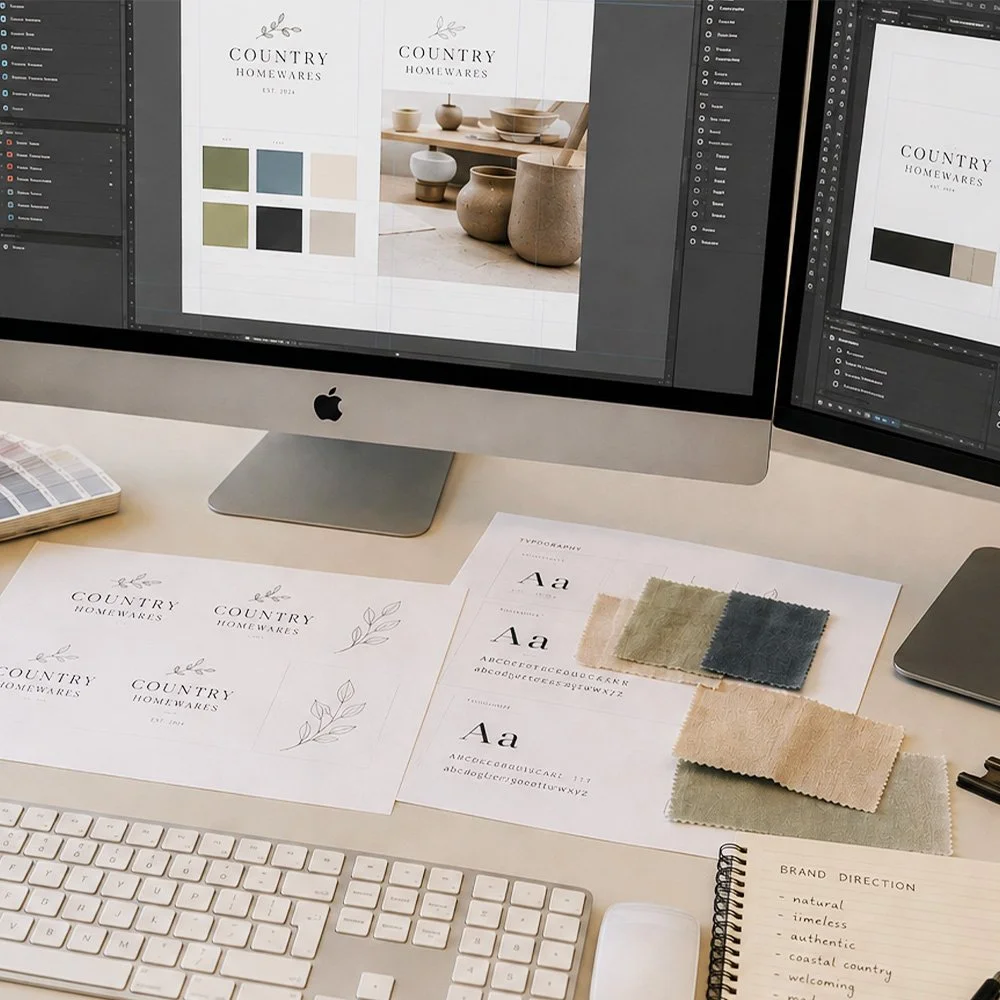
BRINGING IT ALL TOGETHER - STYLE GUIDES & MOOD BOARDS
All of these things usually live in a Style Guide and a Mood Board, and your retail business needs both. These are the rules of your brand. They outline how it shows up visually across all platforms and help to ensure that your brand stays consistent whether you’re doing the design work or you’ve contracted someone else.
Your Mood Board as well as the colour/font page of your Style Guide should be printed and put on the wall above your desk to keep you on brand (owners can be the worst at taking brand shortcuts) and also, share it as part of your onboarding for any creative designers or social media people that you work with. It will help you prevent the dreaded ‘brand slippage’.
Create a Style Guide. I have never met a business that didn’t need a Style Guide. It’s a simple document, often just one page which is the very least a business should have. On it are the colour codes, fonts and other basic information about the brand. Some are more detailed, which is necessary for businesses wanting to really trade off their brand, and they will even show what not to do. For example, it might show not to put an icon over the top of the logo such as a Christmas hat on top of a round logo. It will likely show what the logo will look like in black and white, how to treat the logo if it’s on a dark or light background and it might show where it should be placed on uniforms, posters and even a vehicle.
Canva has excellent Style Guide templates — search "brand style guide" and you'll find several good starting points. They're not fancy, but they're a solid foundation.
Build a Mood Board, it’s the easiest way to demonstrate your brand image. You can do this two ways. Either, get some magazines that your customers might buy or be interested in (fishing, gardening, cars, fashion, cooking) and cut up all the images that you feel represent your brand and stick them on a board or lay them out on a desk, and then take a photo of it. Simple!
Alternatively, search “mood board” or '“vision board” on Canva and then add photos that represent your brand. They don’t have to be of your exact products, you’re just trying to show the essence of the brand. If your business is camping, a combination of scenery, people looking at a fire, breakfast cooking and someone napping with their hat over their face - but all with the colour range and feel that your brand represents. Since this is for internal use only (make sure that’s clear on the document), you don’t need to worry about copyright so you can happily search online for the images that suit your brand.
AVOIDING BRAND SLIPPAGE
Brand slippage happens when small, seemingly harmless changes are made to brand elements (like a logo, colours, or fonts), and over time those tweaks add up causing the brand to no longer look or feel consistent. It’s the gradual erosion of brand identity through off-brand adjustments. Even small adjustments can create brand slippage.
For example, you might tweak the spacing on your logo so that it fits better on a flyer, or slightly alter a brand colour to suit a promotional piece. Each change seems minor on its own, but over time these tiny shifts add up, and soon your brand starts to lose the recognisable look and feel that customers know and trust. That’s why having, and sticking to, your Style Guide is so important. It keeps your brand consistent, no matter the project or the designer.